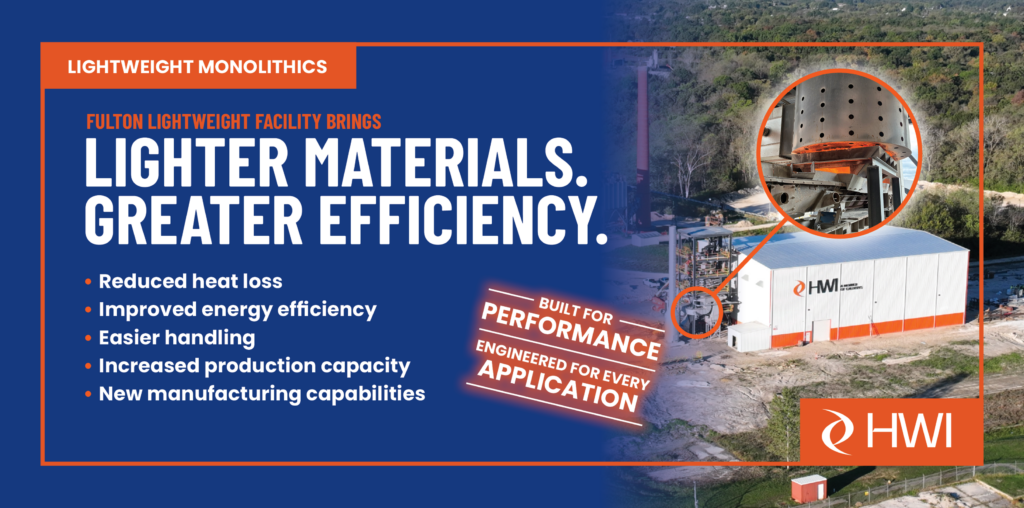
As part of HWI’s continued focus on promoting its monolithic refractory solutions, this article explores the role lightweight monolithics can play in helping customers address thermal efficiency, lining weight, and installation requirements.
In high-temperature applications, reducing heat loss is only one part of the equation. Refractory systems must balance thermal performance with mechanical demands, installation requirements, service life, and the overall design of the equipment.
Lightweight monolithic refractories can be an important part of that balance. By combining low density with insulating properties, these materials can reduce heat transfer and lining weight while supporting improved thermal efficiency.
For applications where thermal performance and weight are key considerations, lightweight monolithics can provide an alternative to traditional dense refractories, insulating firebrick, or rigid board systems.
What Are Lightweight Monolithics?
Lightweight monolithics are castable refractory materials formulated with lightweight aggregates and other carefully selected raw materials to reduce density and thermal conductivity.
Their lower density creates a greater volume of insulating air within the refractory structure, helping limit heat transfer through the lining. Performance varies based on factors such as aggregate type, binder system, density, installation method, operating temperature, and service environment.
The result is a versatile family of materials that can be engineered to meet specific temperature, thermal, and installation requirements.
Why Use Lightweight Monolithics?
A refractory lining is part of a larger thermal and mechanical system. Selecting a different refractory material can influence more than temperature performance alone.
Depending on the application, lightweight monolithics may offer several advantages:
- Reduced heat transfer
Lower thermal conductivity can help minimize heat loss from high-temperature equipment - Lower lining weight
Reduced density can decrease the overall weight of the refractory system - Potential structural benefits
A lighter lining may reduce loads placed on supporting structures, depending on equipment design - Energy efficiency
Improved insulation can help reduce the energy required to maintain operating temperatures - Monolithic installation
Castable materials can conform to complex shapes and geometries that may be difficult to accommodate with rigid products - Installation flexibility
Depending on the product, lightweight materials may be installed by casting, pumping or gunning - Adaptability
Lightweight monolithics can be engineered for different temperature and application requirements
These characteristics make lightweight monolithics particularly valuable in applications where insulation and weight reduction are priorities, and where the refractory is not subjected to extreme mechanical wear or aggressive chemical attack.
When Are Lightweight Monolithics the Right Choice?
The right refractory solution starts with understanding the application—not simply selecting a material based on one performance characteristic.
Lightweight monolithics are generally well suited for areas where thermal insulation and weight reduction are important and where mechanical, chemical, or abrasion demands are within the material’s capabilities.
Key considerations when evaluating a lightweight monolithic include:
- Operating temperature
- Thermal conductivity requirements
- Mechanical and abrasion exposure
- Chemical environment
- Installation method
- Lining thickness and design
- Expected service life
- Overall equipment design
Understanding these factors helps determine where a lightweight material can provide value and where a denser, more wear-resistant refractory may be more appropriate.
Common Applications
Lightweight monolithics are used across a variety of high-temperature industries and equipment where insulation, weight reduction, or installation flexibility are important considerations.
Common applications include:
- Kilns and furnaces
- Heat-treatment equipment
- Boilers and energy equipment
- Aluminum and nonferrous processing equipment
- Iron and steel equipment
- Incinerators and thermal processing equipment
- Chimneys, ducts, and other high-temperature structures
The specific refractory solution should always be selected based on the operating conditions and performance requirements of the application.
HWI’s Approach to Lightweight Monolithics
Lightweight refractory performance begins with the raw materials. HWI has continued to invest in lightweight monolithics technology and manufacturing capabilities, including expanded production capacity and greater control over the production of GREENLITE® aggregate—a critical raw material used in lightweight monolithics and insulating products.
HWI’s vertically integrated approach provides access to high-quality local clay reserves and greater control over GREENLITE® aggregate production. This level of control supports consistency in a key component of lightweight refractory products while strengthening HWI’s ability to manage quality and supply.
These capabilities complement HWI’s broader expertise in refractory materials, manufacturing, and application engineering. Together, they enable HWI to help customers evaluate lightweight monolithics as part of a complete, application-specific refractory system.
Lightweight monolithics are more than insulation. When properly matched to the application, they can play an important role in managing heat transfer, reducing lining weight, improving installation flexibility, and optimizing overall refractory system performance.
About HWI, A member of Calderys
HWI is one of the leading suppliers of refractory products and services in the United States, with a history that spans 160 years. It is part of Calderys and is the brand for the Americas region of the Group. HWI operates an extensive network of manufacturing sites and distribution centers across the Americas, along with the largest refractory industry research facility in North America. Serving virtually every major industry that requires refractory solutions to enhance production and protect assets, HWI is consistently recognized for its talented experts, industry firsts, and intensely driven excellence.
For more information, visit https://thinkhwi.com