Engineering Performance from the Mix to the Finished Lining
A castable may look simple on the jobsite: a dry refractory mix becomes a monolithic lining when combined with water and installed. But behind that process is a complex balance of chemistry, particle packing, bonding, installation characteristics, physical properties, and application-specific performance.
The best castable isn’t necessarily the one with the highest alumina content, the highest strength, or the lowest cement content. A great castable is one engineered to deliver the right combination of properties for the specific application – and to maintain those properties throughout its service life.
For refractory users, that means looking beyond a datasheet and considering the complete performance equation: What will the lining face? How will it be installed? How quickly must it dry out? What type of mechanical and thermal stresses will it experience? And what does the customer need the lining to accomplish?
HWI’s broad monolithic portfolio is designed around those questions, offering castable solutions across a wide range of industries, operating conditions, and installation methods.
The Foundation: Chemistry and Raw Materials
Castable performance starts with the raw materials. But chemistry alone doesn’t determine performance. Particle size distribution and matrix design are equally important. A well-designed castable uses carefully selected aggregate and fine-particle fractions to optimize packing density, reduce voids, and create the desired balance between workability and fired performance.
This is where refractory engineering becomes critical. The objective is not simply to put more refractory material into a mix—it is to create a microstructure capable of performing in the customer’s actual operating environment.
Bonding Technology Matters
The bonding system is another defining characteristic of a castable. Traditional conventional castables use relatively higher cement contents to develop their bond. Low-cement and ultra-low-cement technologies reduce cement content while increasing the refractory portion of the formulation, allowing engineers to optimize high-temperature performance, strength, corrosion resistance, and other properties.
HWI’s portfolio includes solutions ranging from conventional castables to low-cement and ultra-low-cement technologies. Products such as GREENCAST®, ULTRA-GREEN®, FASKAST®, and HP-CAST® represent different approaches to achieving performance in demanding refractory applications.
The right bonding system depends on the application, installation method, dryout requirements, and desired service performance. A well-engineered castable balances these factors rather than optimizing a single specification.
Installation Is Part of Performance
A great castable must perform not only in the furnace, kiln, vessel, or other process equipment—but also during installation.
Flow characteristics, water demand, working time, pumpability, vibration requirements, setting behavior, and dryout characteristics can all influence the quality of the finished lining.
HWI offers castables engineered for a variety of installation methods, including conventional vibrating castables, free-flowing/self-leveling materials, low-moisture formulations, pumping and shotcreting applications, and castables capable of supporting more flexible installation approaches.
For example, HWI’s SPARCAST® family includes low-moisture, low-cement formulations designed for applications including vibrating, pumping, and shotcreting. Our EXPRESS® family includes self-flowing castables designed to minimize or eliminate the need for vibration in appropriate applications.
This matters because installation quality directly affects refractory performance. The best-designed material can still underperform if it is difficult to install correctly.
Strength Isn’t Everything
Compressive strength is one of the most commonly reviewed castable properties – but it is only one part of the performance picture.
Depending on the application, a refractory lining may need to withstand:
• Severe abrasion and mechanical impact
• Thermal cycling and thermal shock
• Molten metal or slag attack
• Alkali or chemical corrosion
• Penetration and infiltration
• High operating temperatures
• Rapid heating and cooling
• Continuous mechanical movement
A castable engineered for abrasion resistance may require a different formulation than one designed primarily for thermal insulation. Likewise, a material optimized for corrosion resistance may have a very different chemistry than one intended for thermal shock.
The goal is application-specific performance—not simply maximum strength.
Matching the Castable to the Application
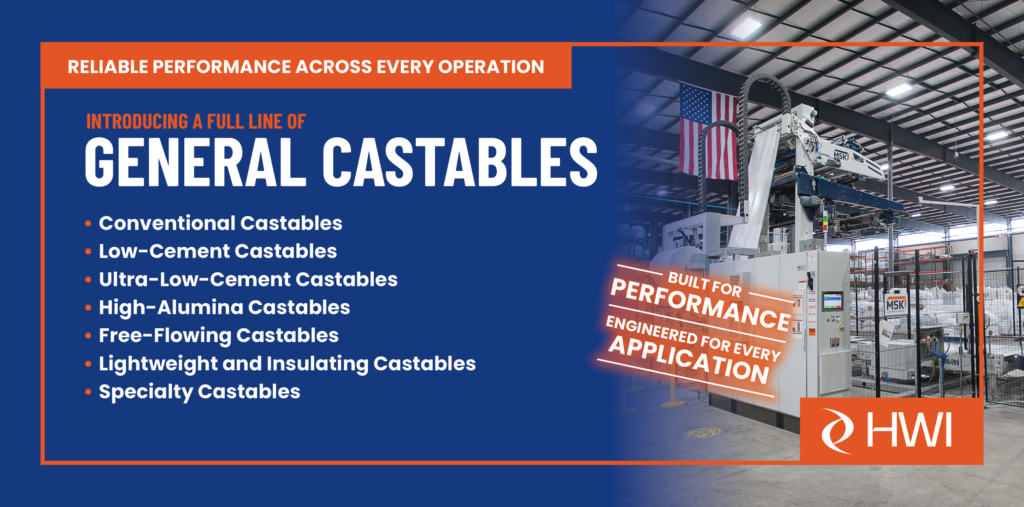
HWI’s castable portfolio includes several major families, each addressing different performance requirements.
- Conventional Castables
- Low-Cement Castables
- Ultra-Low-Cement Castables
- High-Alumina Castables
- Free-Flowing Castables
- Lightweight and Insulating Castables
- Specialty Castables
What Separates a Good Castable from a Great One?
Ultimately, castable performance comes down to how well the material solves the customer’s complete refractory challenge. A great castable should provide:
- Application fit – The chemistry and physical properties are matched to the actual operating environment.
- Installation reliability – The material can be installed consistently using the required method and equipment.
- Predictable dryout – The formulation and installation procedure support safe, controlled water removal.
- Mechanical durability – The lining can withstand the abrasion, impact, erosion, and mechanical stresses it will encounter.
- Thermal performance – The material maintains integrity through operating temperatures and thermal cycling.
- Chemical resistance – The formulation is designed to resist the specific slags, metals, gases, alkalis, or other corrosive agents present.
- Service life – The material delivers reliable performance over the expected campaign rather than simply meeting an initial laboratory specification.
The HWI Advantage: More Than a Material
Choosing the right castable is only part of the solution.
HWI brings together refractory materials, application expertise, installation knowledge, testing capabilities, and technical support to help customers select the right solution for their operating conditions.
That means looking at the complete lining, not just the bag of dirt.
What is the heat profile? What are the wear mechanisms? How will the material be installed? What dryout is required? What is driving premature failure? And what does the customer need to improve—service life, installation time, energy efficiency, reliability, or total installed cost?
Those questions help determine what makes a castable truly great. Because the objective isn’t simply to choose a castable. It’s to engineer a refractory solution that performs.
About HWI, A member of Calderys
HWI is one of the leading suppliers of refractory products and services in the United States, with a history that spans 160 years. It is part of Calderys and is the brand for the Americas region of the Group. HWI operates an extensive network of manufacturing sites and distribution centers across the Americas, along with the largest refractory industry research facility in North America. Serving virtually every major industry that requires refractory solutions to enhance production and protect assets, HWI is consistently recognized for its talented experts, industry firsts, and intensely driven excellence.
For more information, visit https://thinkhwi.com